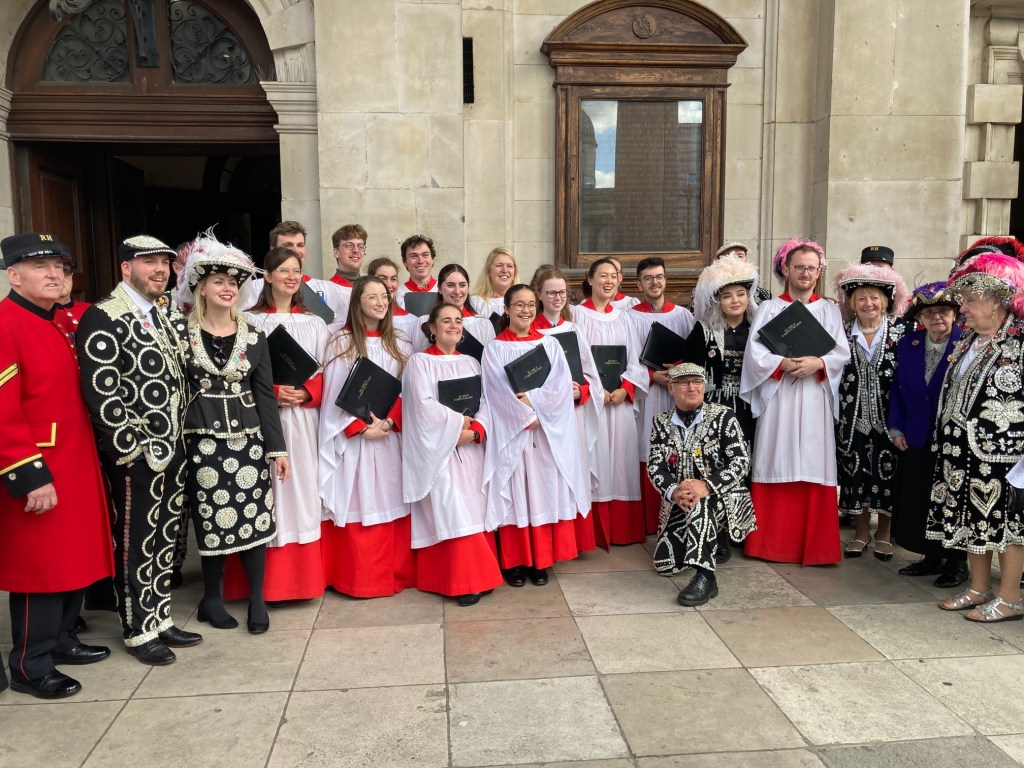
It’s a sunny October Sunday, when I meet a bunch of Pearly Kings and Queens on the steps of St. Martins-in-the-Field off Trafalgar Square, where the Pearly Association have gathered for their annual Harvest Festival. The Pearly Kings and Queens are traditionally associated with East End Cockneys, so I was interested to hear from younger Pearlies what their views were on Cockney and Cockneys in London today.
‘When people see us, they automatically think Rhyming Slang, from East London, Pie and Mash…’, says Jack, the Pearly King of Royal Kensington. Having grown up in Hertfordshire, he’d call his accent ‘common’ but not Cockney, even though he moved back to London 15 years ago. He wouldn’t say the Pearlies promote Cockney culture as much as ‘we promote charity.’ For him, that’s the motivation behind keeping the tradition alive. ‘For us to be relevant and interesting, we need to be modern. There’s nothing we like better than turning up to a modern day event, like a Pride. But then we get asked lots of questions. A lot more people are finding out again who we are.’
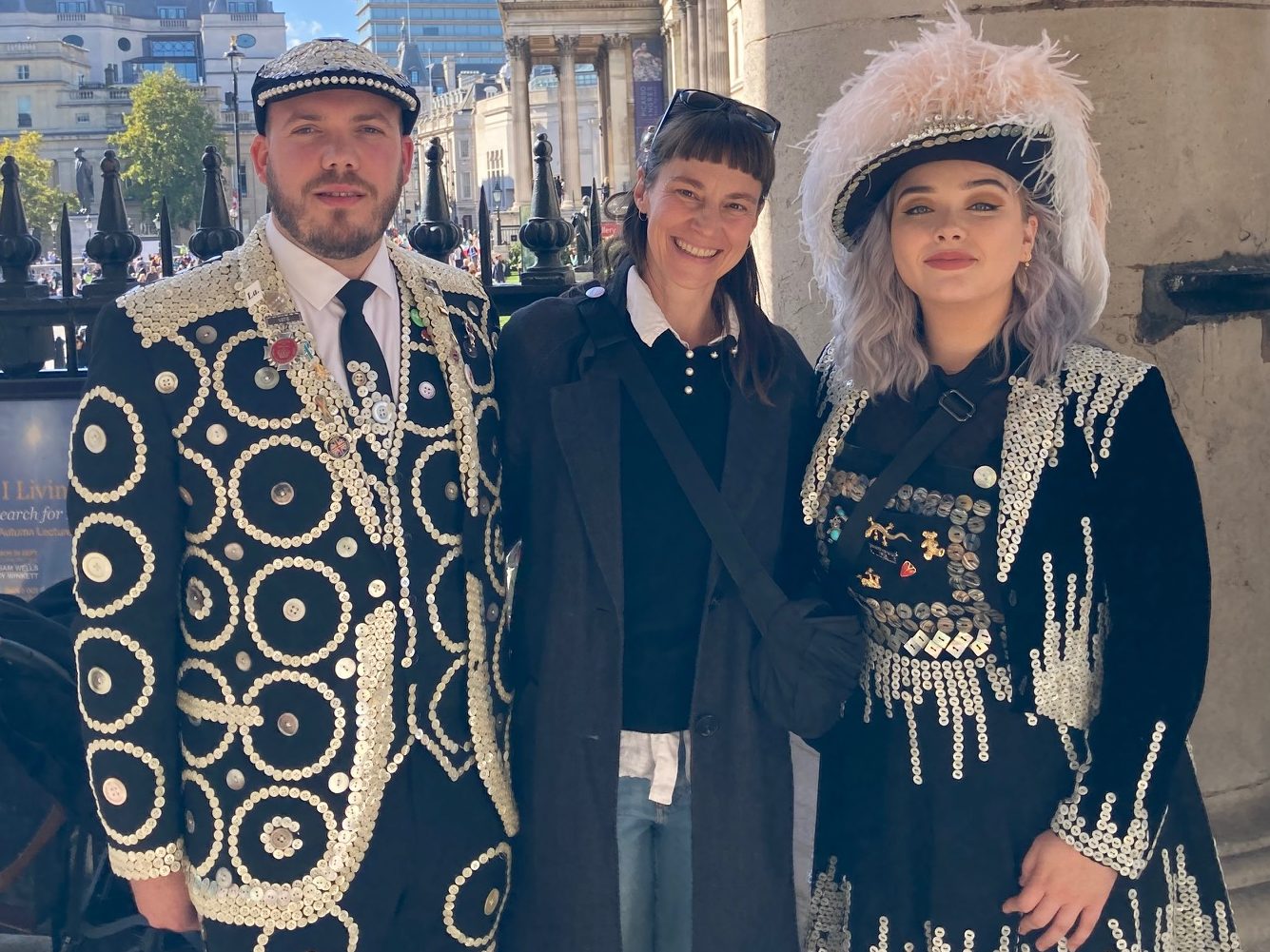
Only recently, the younger Pearlies were interviewed for the glossy Virgin Atlantic magazine under the title ‘Suited and Rebooted’. Jack is convinced that ‘Cockneys will always be around’. He compares Cockney culture and the interest in it to clothing trends. ‘It might go out of fashion but 20 years later, it will come back again’.
There are other things the younger generation does to modernize the tradition. ‘Depending on the pattern on their suit, you would immediately be able to tell which family a Pearly belonged to. My family heritage is playing cards, clubs, hearts, diamonds, whereas as we’re getting more modern, we let the younger generation do their own suits because we wanna show everyone’s individuality’, Jack tells me.
Shannon, the Pearly Queen of Haggerston, says that, to her, being a Cockney and being a Pearly is ‘definitely one and the same’. ‘Being a Pearly is a Cockney tradition, it’s part of the East End. And that’s what being a Cockney is about, being the heart of the East End.’ She calls herself a ‘Cockney’, ‘born and raised in East London’, but ‘I wouldn’t say I was a Cockney speaker’. Her accent is ‘eclectic’. ‘It’s a bit of everywhere, but as is London now, isn’t it?’, she says with a laugh. ‘When I was with my nan, my accent would go way more Cockney than I speak now. My dad is very Cockney, especially when he puts the buttons on. And I’m sure he makes half of it up.’ She is referring to Cockney Rhyming Slang, which is still used in many Pearly families.
Ashley, the Pearly Queen of Royal Kensington, is Jack’s cousin and grew up in Hertfordshire like him. She says, ‘There’s so much of it that’s naturally ingrained in our language. As a family, we never called them ‘feet’ in our house, they’re always ‘plates’ (of meat) and you never went for a ‘curry’, you went for a ‘ruby’ (Murray).’ She remembers Cockney sayings that their grandmother used. For example, when someone asked where something was and she wanted to say: I don’t know, go and look for it yourself, she said it’s ‘under my arm hanging on a brass hook’.
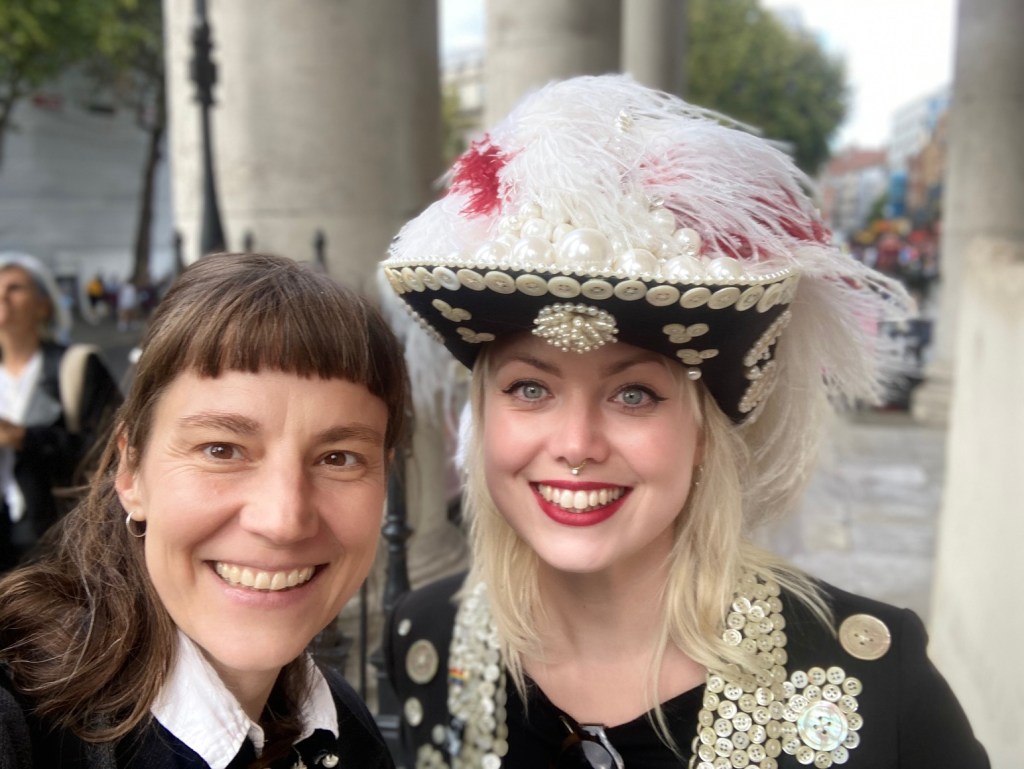
‘At home it’s not even questioned, it’s just how we speak’, Ashley says. And it wasn’t until she went to university that she noticed that it was actually Cockney dialect. She says she speaks with an ‘Estuary’ accent. ‘I’m not a Cockney but I get called a Cockney a lot. When I lived in the north I used to get called a Cockney.’ Her partner Rachel, a Northerner, agrees, ‘I would call her a Cockney’.
Like Jack, Ashley thinks that ‘a Cockney is always going to be an East Londoner, they’re not going anywhere.’ ‘We don’t have people walking down the street talking in Cockney rhyming slang and a pie and mash shop on every corner, but when you meet people who have grown up in the East End, they are still really passionate about that area’.
Ashley rediscovered her passion for her heritage after her grandmother had passed away. ‘When you were a kid, you never really wanted to do it, because it was a bit embarassing. When our nan passed away, it was such a massive part of her life, so I thought this is actually quite a cool family tradition and we shouldn’t let it die out’. To her, things have not actually changed that much. ‘East London is a massive site of migration and it was when the Pearlies were still coming about. It’s always been that way.’ Likewise, the Pearlies of the 21st century ‘are still here, raising money for charity, keeping our heritage alive.’
Amy, the Pearly Princess of Shoreditch, who is also Teresa‘s niece, says, ‘having grown up in Kent, I can’t class myself as a Cockney, maybe a half-Cockney. My mum’s more of a Cockney than I am, even though I started [being a Pearly] before my mum did.’ As the ‘second-oldest charity in London’, ‘we don’t actually want to change that much, just make sure that we’re continuing’, for example through a presence on social media that the younger Pearlies are responsible for. Amy associates ‘Cockney’ with Londoners ‘maybe in their 50s, in the pub’. And she has noticed that Londoners start using Cockney dialect more when they are around the Pearlies. ‘It’s a shame you don’t hear it as much as you used to, but it’s definitely still around, you just have to put on a Pearly suit and bring it out of them.’
Even though members of the younger Pearly generation may have some caveats about calling themselves Cockney (speakers), their identity is still linked to the East End and Cockney culture through their family heritage and their Pearly titles. And their charity work is as timely as ever. After the church service in St. Martins-in-the-Fields, ‘we’re going to a gay bar and have a drink’, says Jack. ‘Although it’s charity work we gotta have a bit of fun with it’.
 LONDON TALKS